

Essential Guide: Citrix UniconOS
Rethinking the endpoint
In this edition of the cloudDNA Essential Guide, cloudDNA CTO Al Taylor is joined by Philipp Benkler, VP and General Manager of Unicon at Citrix, to explore how Citrix UniconOS is changing the role of the enterprise endpoint.
For organisations delivering applications and desktops through Citrix, the endpoint has traditionally been a relatively straightforward part of the architecture. A device connects to a virtual desktop or published application, with most of the processing, management and security controls delivered centrally. However, as applications move towards SaaS and browser based delivery, the requirements placed on enterprise endpoints are changing.
Does every user still need a full Windows operating system? Is a virtual desktop necessary when most applications are accessed through a browser? And could organisations reduce endpoint costs, improve security and extend hardware lifecycles without compromising the user experience?
The discussion covers endpoint security, hardware reuse, simplified management, Windows disaster recovery, Chrome Enterprise integration and the growing opportunity to deliver more value from existing Citrix investments.
Watch the Essential Guide: Citrix UniconOS
Moving beyond the traditional thin client
UniconOS is a hardened, Linux based operating system designed for secure enterprise endpoints. Originally developed as eLux, it has evolved beyond the traditional thin client model and can now operate on laptops, desktop PCs, all in one devices and purpose built thin clients.
Its architecture takes a different approach to conventional Windows endpoints. Rather than starting with a general purpose operating system and applying layers of security controls, UniconOS is designed around a restricted, immutable operating environment. Users access centrally delivered applications, virtual desktops and browser based services without requiring a conventional local Windows installation.
The significance of this approach becomes clearer as application delivery changes. Many organisations continue to rely on Citrix Virtual Apps and Desktops for specialist Windows applications, but an increasing proportion of everyday business software is now delivered through SaaS, web applications and Progressive Web Apps (PWAs). Running a complete virtual desktop simply to launch a browser can introduce unnecessary infrastructure cost and complexity.
UniconOS supports these different application delivery models from the same endpoint. A user might launch a published Windows application alongside a browser based business system or PWA, with each presented through a consistent desktop experience. As applications are modernised, their delivery method can change without requiring the endpoint itself to be replaced.
This gives organisations greater flexibility to modernise applications at their own pace while retaining Citrix for workloads that continue to benefit from centralised application delivery.
Endpoint security by design
Endpoint security remains one of the strongest arguments for adopting a lightweight operating system. Conventional Windows devices often require multiple security and management components, including endpoint protection, configuration management, patching and controls designed to restrict local access to applications and data.
UniconOS approaches the problem differently through its hardened, immutable architecture. The operating system is designed to restrict unauthorised changes and return to a defined state following a reboot, reducing the persistence of unwanted modifications and limiting opportunities for malware to establish itself.
Business applications and data can remain within centrally managed environments rather than being stored locally on the endpoint. This reduces the potential exposure associated with lost or compromised devices, particularly where users primarily consume Citrix applications and browser based services.
The architecture can also reduce dependence on some of the security agents traditionally required on Windows endpoints. However, organisations with specific compliance requirements can still incorporate supported endpoint security integrations where their policies require them.
For IT teams managing large endpoint estates, this creates an opportunity to simplify the security model while maintaining consistent controls across different hardware types and user populations.
Simplifying endpoint management at scale
Managing thousands of endpoints across multiple sites introduces considerable operational overhead, particularly when devices operate over constrained network connections or are distributed internationally.
UniconOS has been developed with these environments in mind. During the podcast, Philipp describes a global financial services customer managing approximately 350,000 endpoints across 65 countries through a single management platform, supported by a small administration team.
A key part of this efficiency comes from how updates are delivered. Rather than repeatedly distributing complete operating system images, UniconOS supports modular updates that transfer only the components requiring change. Local distribution capabilities can further reduce bandwidth consumption by allowing devices to share update content within the same network.
Modern devices also support a dual partition update mechanism. Updates can be installed to an inactive system partition while the user continues working, with the updated environment becoming active following a reboot. This reduces disruption and avoids the lengthy installation processes often associated with conventional endpoint operating systems.
Citrix has also introduced UniconOS Management Cloud, providing a management service hosted within Citrix Cloud. Organisations can use this service without deploying and maintaining their own management infrastructure, while customers with data sovereignty or infrastructure requirements can continue using the on premises management option.
Both approaches remain part of the product strategy, allowing customers to choose the operational model that best suits their environment.
Windows disaster recovery with dual boot
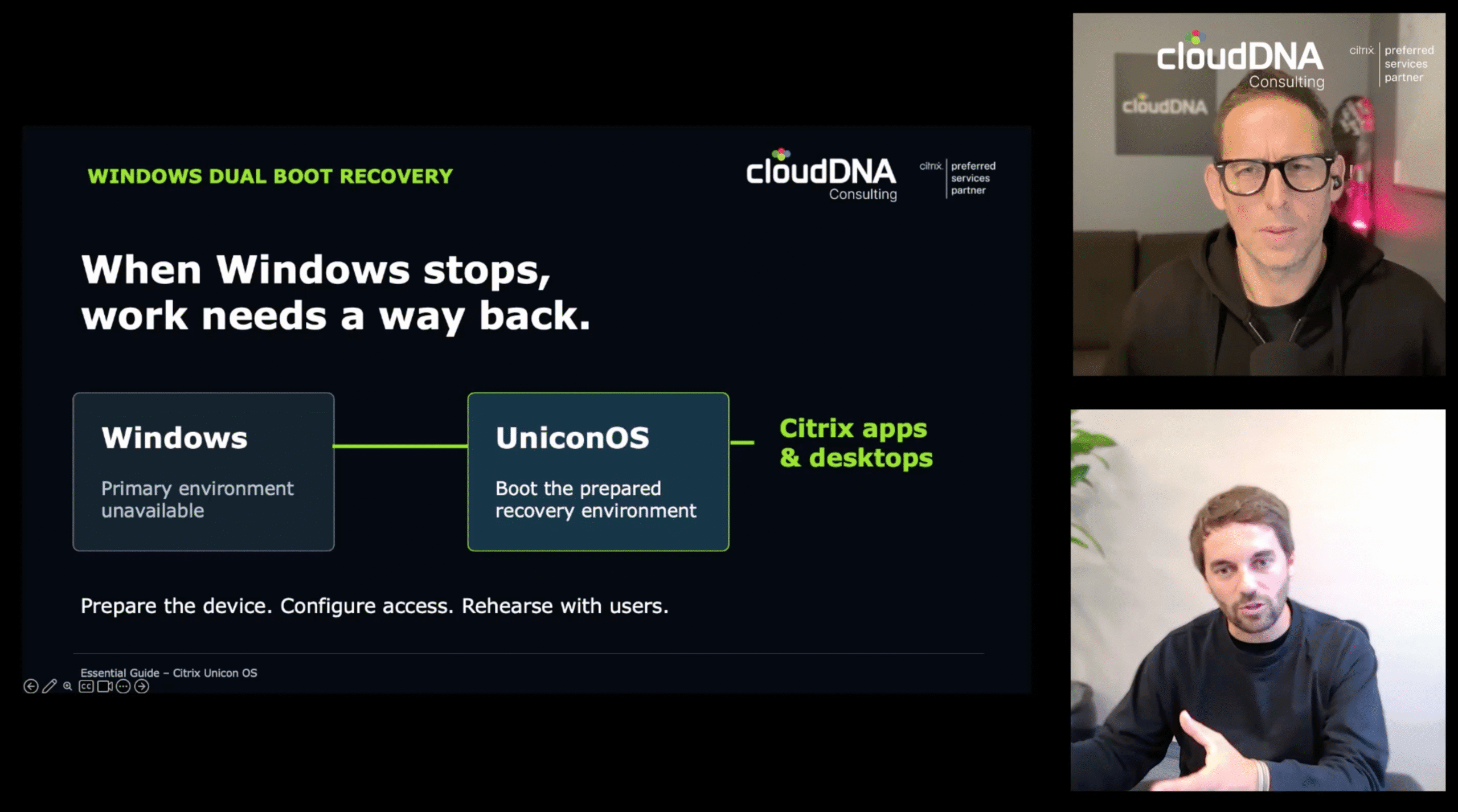
One of the more interesting developments discussed in the podcast is the introduction of UniconOS dual boot, which offers a different approach to endpoint business continuity.
Major Windows endpoint incidents have demonstrated how quickly an organisation can lose productivity when devices become unable to boot or operate normally. Even when applications and backend infrastructure remain available, users cannot work if their local operating system fails.
Traditional recovery approaches often depend on reimaging devices, distributing replacement hardware or providing emergency boot media. These can be effective, but restoring large numbers of endpoints across a distributed organisation can take considerable time and operational effort.
UniconOS dual boot provides an alternative by allowing Windows and UniconOS to reside on separate partitions of the same physical device. Under normal circumstances, the user continues working in Windows. If Windows becomes unavailable but the underlying hardware remains functional, the device can be restarted into UniconOS.
From there, users can access browser based applications, Citrix published applications or virtual desktops, depending on the recovery environment configured by IT. This provides a practical route to restoring productivity without waiting for the Windows installation to be repaired.
The approach is particularly relevant to organisations with large Windows estates that are not yet ready to replace their existing endpoint operating system. UniconOS can provide an additional recovery option while leaving normal working practices unchanged.
For customers with Citrix Platform License or Universal Hybrid Multi Cloud, the inclusion of UniconOS within their existing entitlements makes this an especially interesting business continuity capability to evaluate.
Chrome Enterprise and the modern digital workspace
As more enterprise applications move into the browser, the ability to deliver secure browser based services directly from the endpoint becomes increasingly important.
During the discussion, Philipp confirms support for Google Chrome on UniconOS, including the opportunity to use Chrome Enterprise capabilities. This extends the role of UniconOS beyond connecting users to traditional Citrix workloads and provides another route to delivering a modern enterprise workspace.
The combination is particularly relevant for organisations adopting Citrix SecurAccess with Chrome Enterprise Premium. Citrix can provide contextual application access through Zero Trust Network Access, while Chrome Enterprise Premium introduces additional browser security and data protection controls.
This creates opportunities to support users who require access to SaaS applications, internal web services and published Windows applications without deploying a full local Windows operating system.
It also supports a more gradual approach to application modernisation. Organisations can retain centrally delivered Windows applications where required while moving suitable workloads to PWAs and browser based delivery, without changing the underlying endpoint architecture.
For users, the objective is straightforward: applications remain accessible through a consistent interface regardless of whether they are delivered through Citrix, a browser or a PWA.
Extending hardware life and reducing costs
Endpoint refresh cycles represent a significant cost for enterprise IT teams, particularly when large device estates must be replaced to maintain operating system compatibility or meet increasing hardware requirements.
UniconOS provides an opportunity to reconsider that model. Its lightweight operating system can be deployed on suitable existing PCs and laptops, allowing organisations to repurpose hardware that may no longer be appropriate for a conventional Windows installation.
Where applications and processing are delivered centrally, endpoint hardware requirements can be considerably lower. Devices that would otherwise be retired may remain useful for accessing Citrix applications, virtual desktops and browser based services.
The potential benefits extend beyond the purchase price of replacement hardware. Organisations may also reduce the complexity associated with endpoint maintenance, security software, operating system upgrades and device provisioning.
Extending hardware lifecycles can contribute to sustainability objectives by reducing electronic waste and the environmental impact associated with manufacturing replacement devices. For organisations managing tens of thousands of endpoints, even a modest extension to the replacement cycle can have meaningful financial and environmental benefits.
Supporting specialist enterprise environments
Although the traditional thin client model remains relevant, UniconOS is increasingly being positioned for a wider range of enterprise use cases.
Healthcare is one example where endpoint security, rapid user switching and consistent application access are particularly important. The podcast discusses Citrix’s integration work with Imprivata, including capabilities supporting session roaming and fast user switching.
These capabilities are relevant to clinical environments where staff move between shared workstations throughout the day and need rapid access to their applications without repeatedly establishing new desktop sessions.
Philipp confirms that the integration is already being used by healthcare organisations in the US and Europe, with further development continuing between Citrix and Imprivata. cloudDNA is also working with NHS customers evaluating the technology within their own environments.
Other use cases include distributed branch networks, financial services, shared workstations, contractors and organisations looking to provide secure access to business applications from repurposed hardware.
The common requirement is a manageable, secure endpoint that can support different application delivery models without introducing the full operational overhead of a conventional desktop operating system.
Getting more value from the Citrix platform
For existing Citrix customers, UniconOS represents an opportunity to extend the value of their investment beyond virtual applications and desktops.
The inclusion of UniconOS within Citrix Platform License and Universal Hybrid Multi Cloud means eligible organisations may already have access to the technology required to evaluate a different endpoint strategy.
This changes the starting point for many customers. Rather than immediately considering a new endpoint platform or another licensing investment, IT teams can assess whether UniconOS can address existing challenges around Windows management, endpoint security, hardware refresh costs and business continuity.
It also reinforces the wider direction of the Citrix platform. As organisations adopt more SaaS applications, browser based services and hybrid application delivery models, Citrix can continue providing a consistent workspace experience across both traditional and modern workloads.
UniconOS provides the endpoint component of that architecture, allowing organisations to modernise application delivery without requiring every user to adopt the same device or desktop model.
Where to start with UniconOS
The first step is to understand the applications and user requirements across the existing endpoint estate.
Some users will continue to need full Windows desktops, while others may only require access to published applications, SaaS platforms and browser based services. Shared workstations, specialist environments and devices approaching the end of their supported Windows lifecycle may offer particularly suitable starting points.
A focused evaluation can assess hardware compatibility, application delivery requirements, peripheral support, security policies and management options. For organisations retaining Windows, dual boot also provides a separate business continuity use case that can be tested without immediately changing the primary endpoint operating system.
The objective should not be to replace Windows everywhere, but to identify where a simpler, more secure and centrally managed endpoint can provide measurable operational and commercial benefits.
Explore Citrix UniconOS with cloudDNA
cloudDNA helps organisations assess where Citrix UniconOS fits within their existing Citrix environment, from repurposing Windows devices and simplifying endpoint management through to evaluating dual boot disaster recovery and secure browser based application delivery.
As a Citrix Preferred Services Partner and Finalist for Citrix EMEA Technical Services Partner of the Year 2026, our technical team can help identify suitable use cases, assess existing licensing entitlements and support proof of concept and pilot deployments.
Whether you’re looking to extend hardware lifecycles, reduce endpoint management overhead or build a more resilient workspace, UniconOS provides an opportunity to rethink what the enterprise endpoint needs to deliver.
Speak to cloudDNA about Citrix UniconOS, call 0330 010 3443 or email hello@clouddnagroup.com to discuss your requirements.