
Essential Guide:
NetScaler AI Gateway
Enterprise AI is moving quickly from experimentation into production. Employees are using generative AI services, developers are embedding Large Language Models into applications and AI agents are beginning to interact directly with enterprise systems, data and workflows. That creates a new challenge for IT and security teams. Traditional application security was designed around relatively predictable interactions between users, applications and APIs. AI introduces new traffic flows, new security risks and increasingly autonomous interactions between models, agents and enterprise resources.
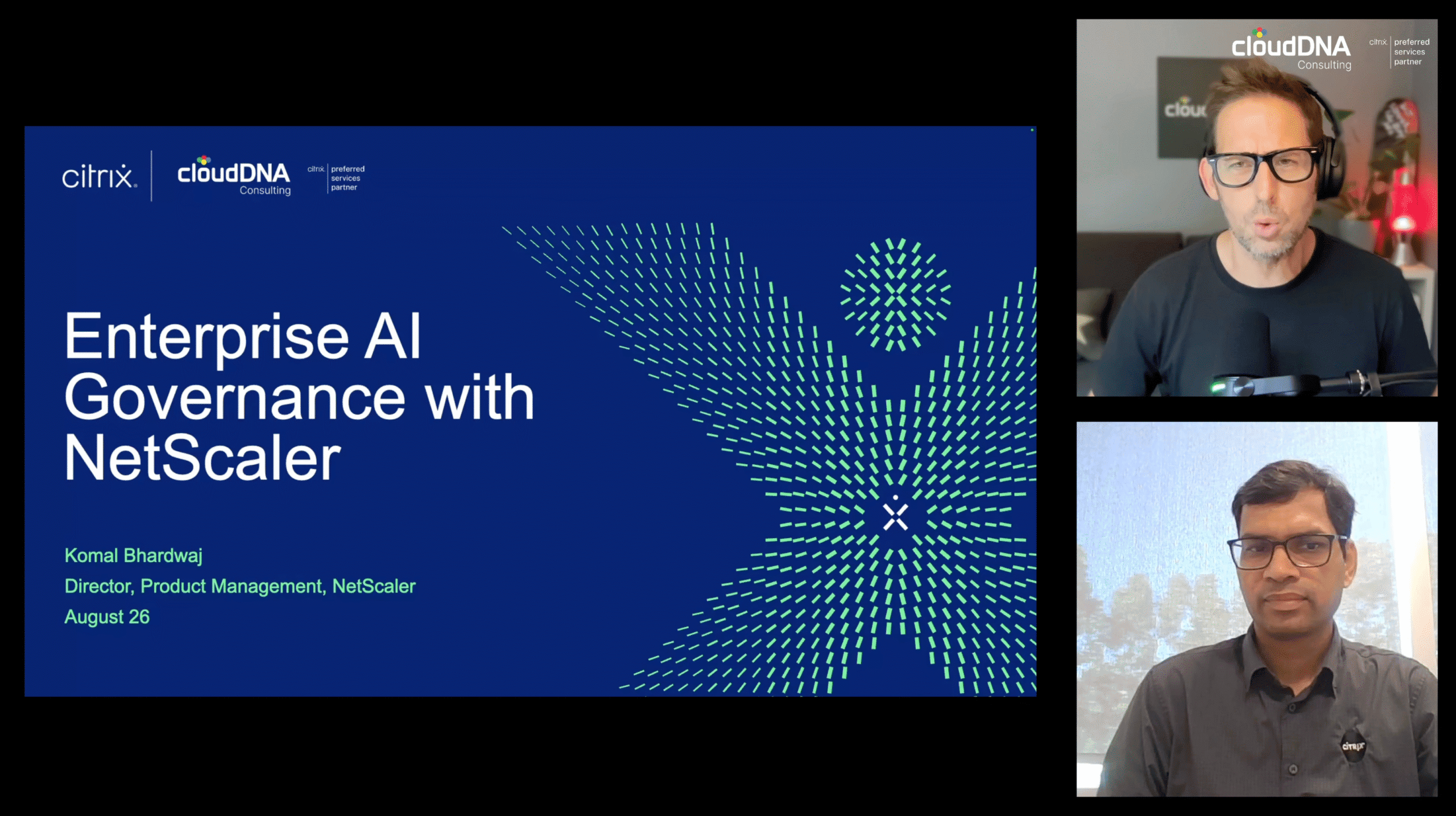
In the Essential Guide: NetScaler AI Gateway, we explore what this means for enterprise infrastructure and how NetScaler is evolving to provide a control point for both LLM and agentic AI traffic. The conversation covers NetScaler AI Gateway, MCP Gateway, securing AI applications, controlling access to services such as Claude Code, AI security risks and the growing importance of governance as AI moves into production. If you are responsible for NetScaler, application delivery, security, infrastructure or enterprise AI strategy, it is a conversation worth watching.
Watch the Essential Guide: NetScaler AI Gateway
Bringing AI traffic under control
As AI moves from experimentation into production, organisations are encountering a familiar infrastructure problem in a very different part of the technology stack. Applications need reliable access to services, users and workloads need to authenticate, traffic needs to be secured and IT teams need visibility of what is being consumed. The difference is that the destination is increasingly a Large Language Model, with applications communicating with services such as OpenAI, Anthropic and Google alongside private models. Without a common control point, those connections can quickly become difficult to manage. Individual development teams may implement authentication differently, applications can connect directly to multiple providers and security teams have limited central visibility of where AI traffic is going, what information is being exchanged and how much is being consumed.
NetScaler AI Gateway provides a common layer between enterprise applications and the AI services they use. Traffic can pass through NetScaler where organisations can apply authentication, security policies, routing, rate controls and visibility rather than requiring each application team to solve these challenges independently. For existing NetScaler teams, the principle is familiar. NetScaler already sits in the application data path, applying policy to application and API traffic. AI Gateway extends that established role to a new generation of applications without requiring a completely separate infrastructure stack.
AI Gateway, MCP and autonomous AI
The challenge becomes more significant as organisations move beyond generative AI and start adopting AI agents. These systems can interact with tools, services and corporate data to complete tasks, potentially querying databases, accessing code repositories, calling APIs or initiating business processes. This is where the distinction between NetScaler AI Gateway and MCP Gateway becomes important. AI Gateway provides controls around communication between applications and LLM services, while MCP Gateway addresses interactions between AI clients and the tools and resources available through Model Context Protocol. Together, they provide control over both the models an organisation consumes and the enterprise resources that AI agents can access.
The implications change when an AI system can take action. Excessive permissions could allow an agent to cross an unintended security boundary, while manipulated instructions could potentially result in an action rather than simply an inappropriate response. An incorrectly configured workflow or agent caught in a loop could also generate significant model consumption, turning a technical problem into a financial one. MCP Gateway provides a managed point between AI clients and approved MCP servers, allowing organisations to govern those interactions rather than allowing agents to establish unmanaged connections to tools across the enterprise.
A new application security challenge
AI applications introduce risks that conventional application controls were not specifically designed to address. Prompt injection can attempt to influence application behaviour, sensitive information can be exposed through prompts and responses, and insecure model output can create further risk when consumed by another application or process. Agentic AI adds another dimension through excessive permissions and access to enterprise tools.
The OWASP guidance for LLM and generative AI applications provides a useful framework for these risks, but enterprises still need a practical way to apply controls consistently. Securing the application endpoint alone does not provide complete visibility of interactions between applications, models, agents and enterprise services.
Putting NetScaler in the AI data path provides a central point where policy can be applied without designing a separate governance model around every AI service. It can also provide insight into AI traffic and consumption, helping organisations understand which users and applications are consuming services and identify unexpected levels of usage. This becomes increasingly useful in a multi model environment. Different models have different capabilities, performance characteristics and costs, and there is little reason to assume every workload should use the same provider. Centralised routing and policy can give organisations greater choice over how AI requests are handled while retaining a consistent control layer.
From concept to a real enterprise use case
AI coding assistants provide a good example of where the gateway model becomes tangible. Tools such as Claude Code can deliver significant value to development teams, but enterprise adoption introduces questions around authentication, model access, consumption and governance. If every developer establishes an independent relationship with an AI provider, organisations can quickly end up with fragmented access and limited visibility. Using NetScaler as an LLM Gateway provides an alternative, allowing developers to access AI services through a common enterprise control point where access policies can be applied consistently.
The significance extends beyond Claude Code. Development tools are an early example of AI becoming embedded into everyday enterprise workflows. A gateway architecture provides a consistent layer between those applications and a rapidly changing ecosystem of models, allowing organisations to introduce or change AI providers without rebuilding governance each time. It also creates greater flexibility around cost and resilience. Organisations can make more deliberate decisions about which models handle particular requests, while reducing the dependency created when a production application connects directly to a single external AI provider.
Why NetScaler customers should be looking at AI Gateway
For organisations already using NetScaler, AI Gateway is particularly interesting because it builds on a platform that may already sit at the centre of their application delivery and security architecture. NetScaler has evolved beyond traditional load balancing into WAF, API security, bot management, DNS security and Kubernetes ingress. AI Gateway and MCP Gateway extend that footprint into emerging AI architectures rather than requiring customers to introduce another standalone platform.
There is also an important commercial consideration. Organisations with Citrix Platform License or Universal Hybrid Multi Cloud may already have NetScaler entitlements that can be used to explore these capabilities. The starting point may therefore be understanding what is already available within the existing Citrix investment rather than beginning another technology procurement exercise.
For existing NetScaler customers, this combines established platform knowledge and operational processes with an opportunity to address a new workload. The wider combination of ADC, WAF, API security, AI Gateway and MCP Gateway can also support organisations looking to consolidate more application delivery and security functions onto a smaller technology footprint.
Where to start
The best starting point is to understand how AI is already entering the organisation. Developers may be consuming LLM APIs, employees may be using public AI services, applications could be exchanging corporate information with external models and early agent projects may already be connecting AI to internal systems and data. Mapping these use cases provides a clearer basis for deciding where controls are required. IT and security teams can identify which models are being used, what information is being exchanged, who requires access and where AI agents are beginning to interact with enterprise tools.
From there, organisations can decide where authentication, security, routing, consumption controls and visibility need to be introduced. The aim is to establish an enterprise control layer that is independent of any individual model provider, giving the business greater flexibility as AI technology and services continue to change.
For Citrix and NetScaler customers, that assessment should also include existing licensing and infrastructure. The capabilities required to start building that control layer may already be available within the platform.
Explore NetScaler AI Gateway with cloudDNA
cloudDNA can help organisations understand where NetScaler AI Gateway and MCP Gateway fit within their existing architecture, assess current Citrix and NetScaler entitlements and identify practical use cases for evaluation. This can range from securing LLM access and development tools through to governing AI applications, MCP traffic and emerging agentic workflows.
As a Citrix Preferred Services Partner and Finalist for Citrix EMEA Technical Services Partner of the Year 2026, our focus is on practical adoption and helping customers extract more technical and commercial value from the NetScaler capabilities available to them.
To explore NetScaler AI Gateway, visit clouddnagroup.com/netscaler, call 0330 010 3443 or email hello@clouddnagroup.com.